Too much and not enough

“AuDHD” isn’t a clinical label, but a community-coined term describing the overlap of autism and ADHD traits. Both are neurodevelopmental differences: ADHD typically involves challenges with attention, impulsivity, and regulation, whereas autism often involves social-communication differences, sensory sensitivity, and a need for sameness. Importantly, research shows these profiles frequently coexist. Studies suggest roughly 30–50% of autistic individuals show significant ADHD symptoms, and two-thirds of people with ADHD have autistic features. In practical terms, many adults may have both diagnoses. A large 2024 study even found about 1% of a school-aged population carried both ADHD and autism diagnoses, hinting at how common AuDHD really is.
The core of this experience is the push-pull clash between ADHD and autism drives. An autistic-ADHD person might crave both novelty and routine, social contact and solitude, high stimulation and rest. For example, Ella – diagnosed with autism in her 30s and ADHD later – describes how she would meticulously create a daily routine to feel less anxious (an autism strategy), but “the newness of it felt exciting and fun. Then I’d start to feel restless, needing something new and stimulating… I became overstimulated by my dopamine-seeking ADHD, but bored, sad and restless when trying to live within too rigid a structure.”. In other words, a schedule that calmed her autistic side ultimately frustrated her ADHD side.
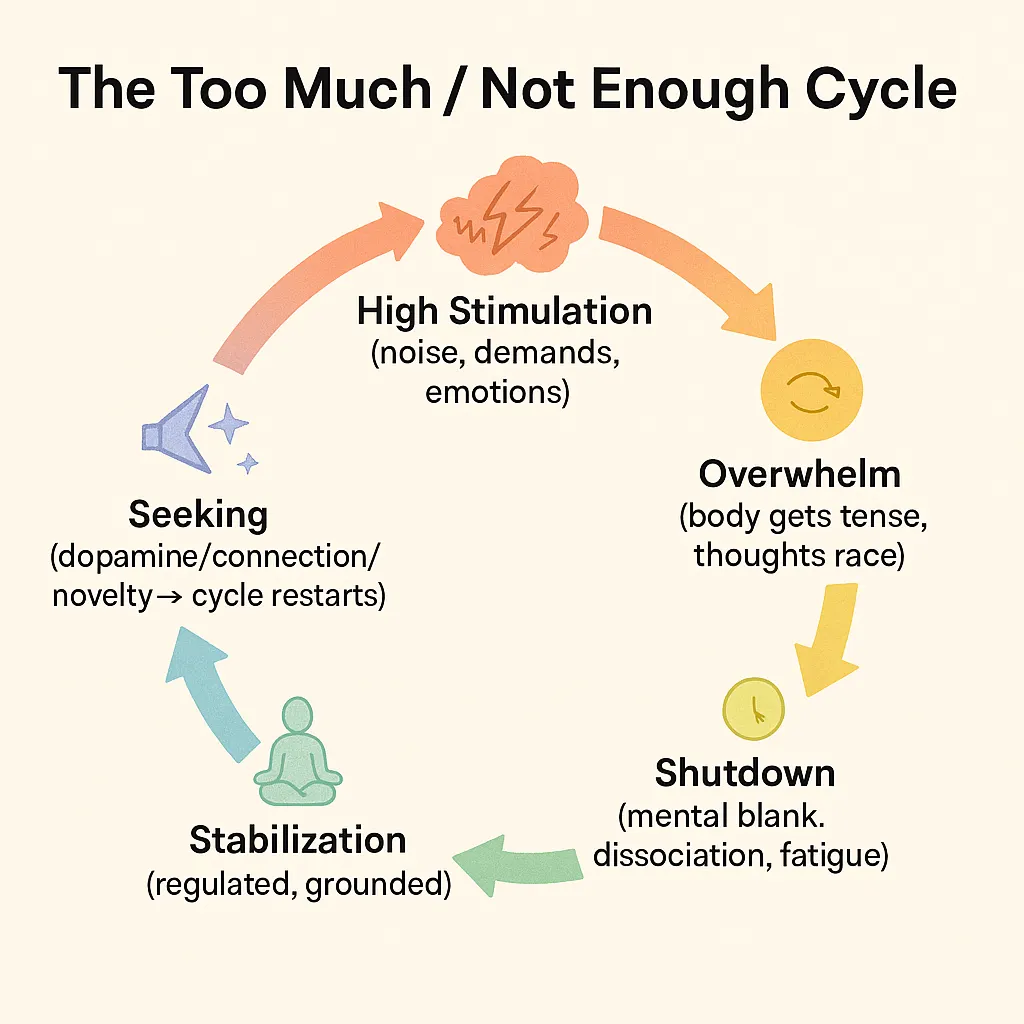
Clinically, this means AuDHD adults often feel inconsistent and misunderstood. One moment they’re bursting with energy, the next they collapse from sensory overload or exhaustion. They may be labeled “hyper” or “shy,” “manic” or “depressed,” depending on which side shows up. The oscillation can erode self-esteem. After a lifetime of mismatches, many report poor mental health and low self-worth.
In fact, a review found that children with both ASD and ADHD show greater executive dysfunction than those with either alone. In lay terms: the brain hardware that manages focus, inhibition, and social processing is already stressed by one diagnosis; having both means this system constantly pulls in opposite directions.
Put simply, the AuDHD brain is often hyper-reactive. When stimuli arrive – sounds, lights, emotions – it can over-respond (“too much”) until it system-shuts down from overload (“not enough” energy left). Think of it like a car whose accelerator (ADHD) and brakes (autism) both have quirks. The car zooms forward unpredictably (hyperfocus, impulsivity, bursting energy) but can also stall or hesitate (shutdowns, blanking out) when the gears slip. This “too much/not enough” rollercoaster is an emergent property of the neurobiology of AuDHD.
Merged from Coping Tips and Strategies
Coping Tips and Strategies
Living AuDHD-style means learning creative strategies to balance those extremes. Below are some research-backed and community-tested suggestions:
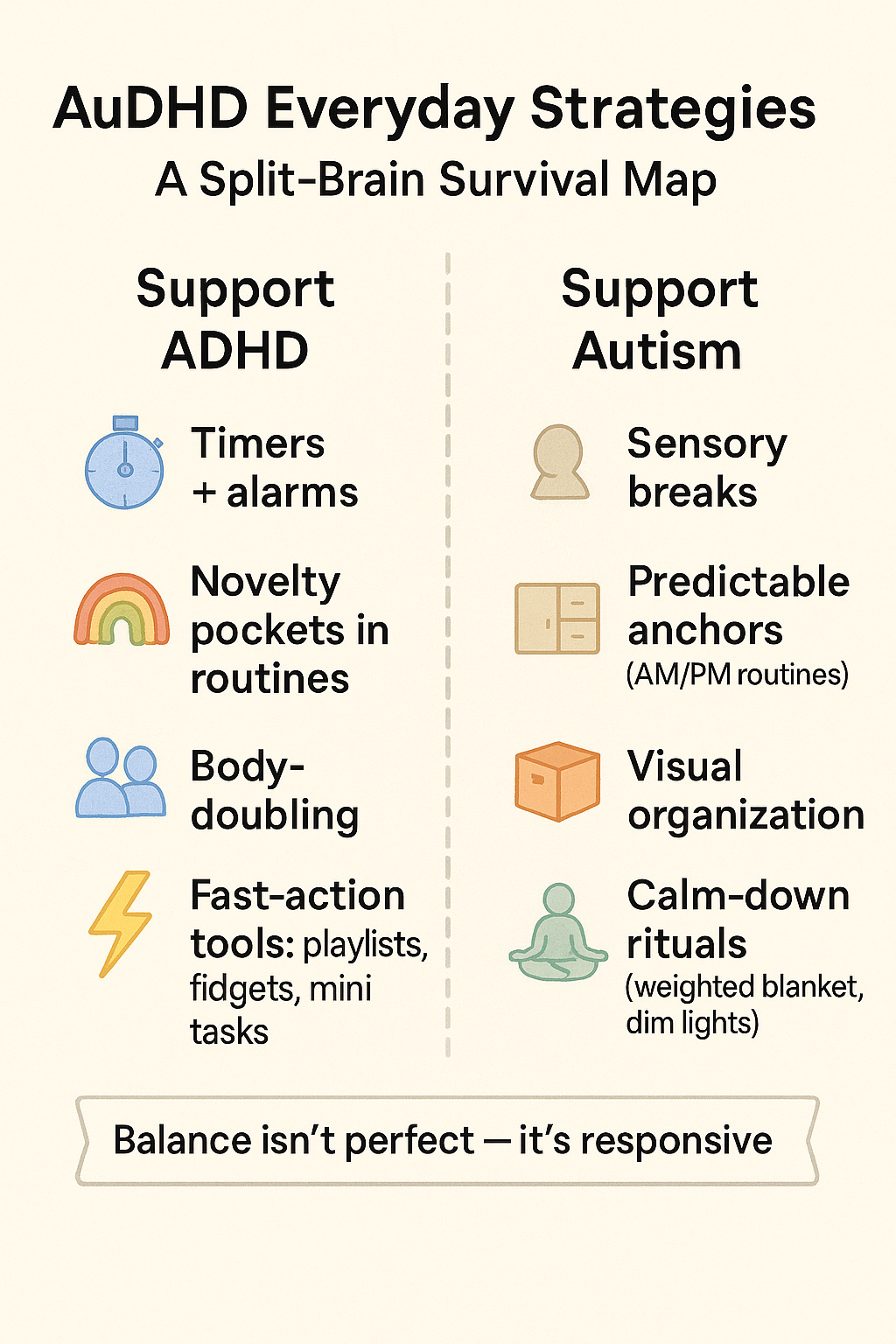
- Build flexible routines. Routines give structure (helpful for autistic brains), but add small allowances for novelty (needed by ADHD). For example, set a loose “morning routine” or “evening routine” rather than a minute-by-minute schedule. Ella found it helped to create mini-routines for specific times of day, giving herself predictability and room for spontaneity.
- Channel ADHD energy safely. Instead of always needing to go out for stimulation, find intense activities at home. Ella learned to substitute outings with video games, online chats, or even loud music – ways to get a dopamine boost without burning out. Brainstorm a list of engaging home activities (creative projects, gaming, exercise videos) that satisfy hyperactivity but are under your control.
- Honor downtime. Schedule regular “sensory breaks.” After social events or focused work, give yourself permission to rest quietly. Turn off lights, wrap in a cozy blanket, or listen to calming music. This respects the autistic need to recharge and can prevent meltdowns.
- Use tools for organization. Leverage apps, timers and planners to manage forgetfulness and time blindness (common in ADHD). An alarm or phone alert can signal transitions. Visual schedules or checklists can support executive function when planning tasks. Even something like an egg timer or a calendar app can provide structure that’s easier to follow than relying on memory.
- Learn your triggers and limits. Keep track of when you hit “too much” or “shutdown” states. Is it noisy environments? Endless social obligations? Overly rigid schedules? Once you identify triggers, you can often adapt: maybe wear headphones in crowds, politely decline extra plans, or simplify your schedule. Knowing you’re prone to people-pleasing, for instance, can help you practice saying “no” without guilt.
- Engage in special interests mindfully. Deep dives into passions can be very soothing (autism special interests), but can also be hard to sustain (ADHD distractibility). Try setting small goals: e.g. “I’ll work on this hobby for 30 minutes, then take a 10-minute break.” Breaking activities into short bursts can capture focus without frustration.
- Seek professional support. Therapy or coaching from someone experienced with neurodiversity can help. Cognitive-behavioral strategies, mindfulness, or social skills coaching may be tailored for AuDHD needs. Some adults find that ADHD medication provides a “pause point” – making them less impulsive so they can apply other strategies. If medication is an option, discuss it with a doctor who understands both ADHD and autism.
- Connect with community. Joining support groups (in-person or online) for autistic adults, ADHD adults, or AuDHD specifically can be hugely reassuring. Sharing tips and frustrations with others who “get it” reduces loneliness. Research notes that a late autism diagnosis “can even help you feel connected to a community where you feel understood and accepted”. You might also find local meetups for neurodiverse adults or online forums where people swap coping techniques.
This is a copy of someone else's work, kept as a source. Original: AuDHD & The “Too Much / Not Enough” Paradox